
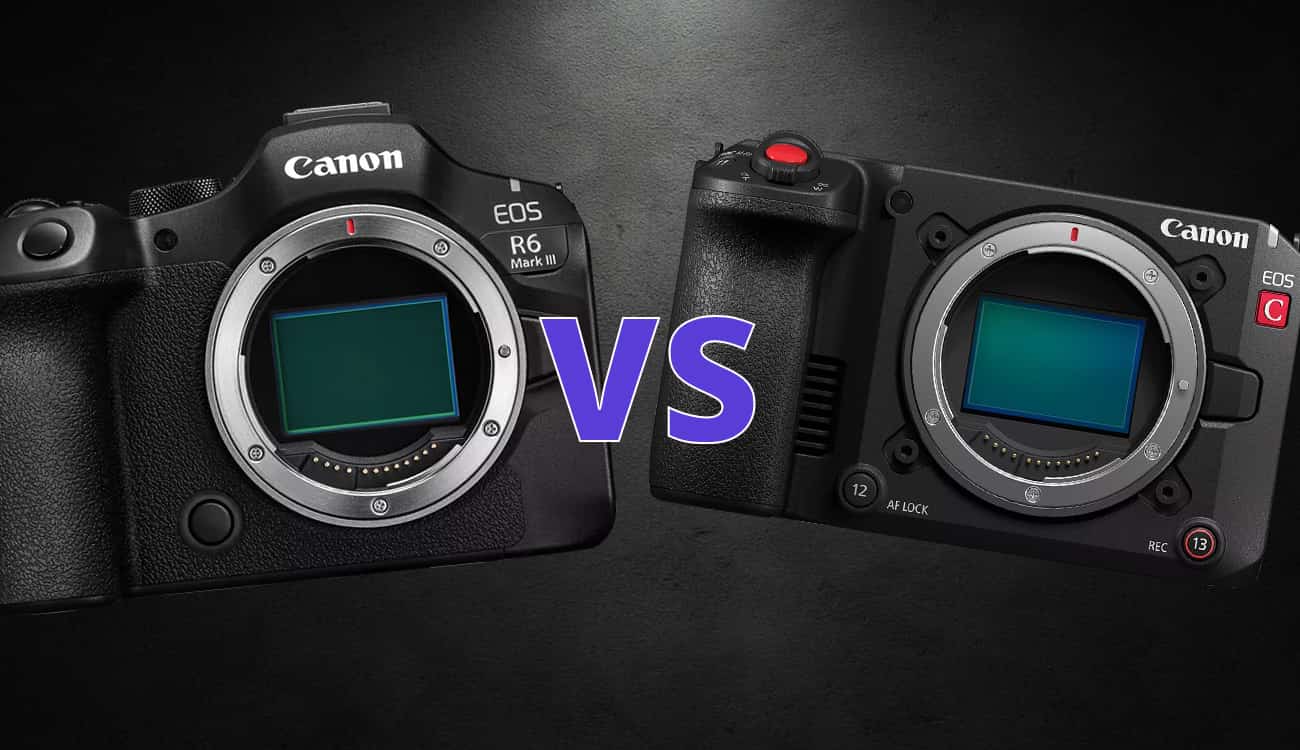
Canon EOS R6 Mark III vs Canon EOS C50: Which 7K Canon Camera Should You Buy?
If you shoot video on Canon and you’re trying to decide between the new Canon EOS R6 Mark III and the Canon EOS C50 cinema camera, you’re not alone. Both cameras share a 7K full-frame sensor, RF mount, and serious video specs, but they’re aimed at very different creators. With roughly a $1,000 price gap between the R6 Mark III and the C50, the real question is: is the Canon C50 worth the extra money over the Canon R6 Mark III?
Quick Links – Buy the Canon EOS R6 Mark III or Canon EOS C50
These affiliate links help support SLATD at no extra cost to you.
Big Picture: Canon R6 Mark III vs Canon C50 in One Paragraph
On paper, the Canon EOS R6 Mark III and Canon EOS C50 look surprisingly similar: both have a high-resolution full-frame 7K sensor, 7K RAW recording, 4K 120p, RF mount, Canon Log 2/3, and serious pro autofocus. The main difference is philosophy. The R6 Mark III is a hybrid mirrorless camera built for creators who shoot a mix of stills and video, need in-body image stabilization (IBIS), and want something that works as a daily shooter and a YouTube / wedding / documentary workhorse. The C50 is a cinema camera first—with dual base ISO, pro monitoring, timecode, and a boxy body with XLR top handle—that’s built to live on sets, in rigs, and on productions where video is the only priority.
Price & Value: How Big Is That $1,000 Gap Really?
At launch, the Canon EOS R6 Mark III body sits at around $2,799 USD, while the Canon EOS C50 body hovers around $3,899 USD. That’s roughly a $1,000–$1,100 difference just for the body, before lenses, media, cages, or audio.
Think about what that extra thousand could buy:
- A fast RF prime (or two slower ones) for your R6 Mark III.
- A proper gimbal plus ND filters and audio recorder.
- A starter RF zoom like a 24–105mm paired with a budget prime.
So the question becomes: do the cinema features of the C50 actually make you money or save your crew time? If yes, the premium can be easy to justify. If not, that budget may be much better spent on glass, lighting, audio, and support gear around the R6 Mark III.
Canon EOS R6 Mark III Advantages – Hybrid, Handheld, and Creator-Friendly
1. In-body image stabilization (IBIS) for handheld and run-and-gun
The R6 Mark III has 5-axis IBIS rated up to roughly 8+ stops of compensation with supported RF lenses. For real-world shooters that means:
- Smoother handheld video without a gimbal.
- More usable low-light footage without cranking ISO.
- Stabilized stills for events, weddings, and documentary work.
The C50 does not have mechanical IBIS. It relies on lens IS plus digital stabilization, which is helpful but not the same as a floating sensor when you’re walking handheld or vlogging.
2. Built-in EVF and classic camera ergonomics
The R6 Mark III mirrorless body gives you:
- A high-res electronic viewfinder for bright outdoor shooting and precise focus checks.
- A familiar DSLR-style grip and control layout that feels natural for photographers.
- A more “normal camera” footprint for travel, street, BTS, and low-profile documentary shooting.
The C50 is a box-style cinema camera with no EVF. You’re living on the rear LCD and/or external monitors almost all the time.
3. True hybrid stills + video performance
If you need one body to shoot stills and video on the same day, the R6 Mark III is the better tool:
- High-res stills from a 32.5MP sensor with up to 40 fps bursts in electronic shutter mode.
- Photo-focused ergonomics, drive modes, and menus that make it feel like a “real” stills camera.
- Great for hybrid shooters doing weddings, events, corporate portraits, and key art.
Yes, the C50 can shoot stills, but its UI and body design are unapologetically cinema first.
4. Lower price and more budget left for lenses, audio, and lights
That roughly $1,000 price difference is a huge deal for indie creators and small studios. With the money you save by choosing the R6 Mark III, you can:
- Pick up a fast RF prime for shallow depth-of-field talking heads.
- Invest in proper audio (shotgun mic + lav system).
- Build a basic lighting kit that levels up your overall production more than a cinema badge on the camera ever will.
5. Who the R6 Mark III is for
- YouTubers and content creators who shoot handheld, vlog, and need IBIS and an EVF.
- Wedding and event filmmakers who also deliver stills to the client.
- Hybrid commercial shooters doing product, lifestyle, and social campaigns on one body.
- Documentary shooters who travel light and need something that can be A-cam one day and B-cam the next.
Canon EOS C50 Advantages – Compact Cinema Camera for Serious Productions
1. Pro video body with cooling, timecode, and better I/O
The Canon EOS C50 is part of Canon’s Cinema EOS line, and it behaves like a cinema camera:
- Compact box-style body that rigs easily into cages, car mounts, drones, and gimbals.
- Active cooling and cinema-oriented heat management for longer, more reliable recording in hot environments.
- Timecode support and more robust physical connections so it plays nicely on multi-camera sets.
If you’re living on set all day, reliability and I/O can matter more than IBIS, especially when the camera is rigged or locked off.
2. Dual base ISO and low-light image quality
The C50 features a Dual Base ISO design (e.g. 800 and 6400 in Canon Log 2), which gives you more consistent noise performance across a wide range of lighting conditions and helps preserve dynamic range in challenging low-light setups.
The R6 Mark III has excellent high-ISO performance, but does not have true dual base ISO. If you’re constantly bouncing between bright exteriors and dark interiors on the same shoot day, that dual base ISO can be a real quality-of-life and image-quality win.
3. Cinema menus, tools, and monitoring
The C50 runs Cinema EOS firmware, which is designed around video crews:
- Dedicated video-oriented menu structure and monitoring options.
- Advanced waveform, vectorscope, false color, and anamorphic support (depending on mode).
- More nuanced control over codecs, bitrates, and proxy / dual-record workflows.
If you’re used to Canon cinema cameras, the C50 will feel like a tiny version of the bigger C-series bodies, making it a natural B-cam or C-cam on a Canon set.
4. Included top handle with XLR audio
One of the big value props of the C50 is the included top handle with built-in XLR inputs. That means:
- Balanced XLR audio directly into the camera (shotgun + lav, or 2 lavs, etc.).
- Physical knobs and switches for gain, phantom power, and input routing.
- A rigid mounting point for top-mounted monitors or wireless video gear.
You can absolutely get XLR audio onto the R6 Mark III via a hot-shoe module or external recorder, but it adds cost and mess. With the C50, pro audio is part of the package.
5. Who the C50 is for
- Small production companies doing narrative, branded docs, and commercial work with crews.
- Owner-operators who already have a Canon cinema A-cam (C70, C80, C300, C400, etc.) and want a perfectly matched compact B-cam.
- Gimbal / crash / remote camera use where IBIS is less important and reliability + timecode matter more.
- Teams that record all day in 7K RAW and need active cooling and video-first ergonomics.
Real-World Use Cases: Which Canon 7K Camera Fits Your Shoot?
Weddings & Events
For wedding filmmakers and event shooters, the Canon EOS R6 Mark III is usually the better choice: IBIS, EVF, and stills capabilities matter a lot. You’re moving constantly, often solo, and you might be shooting photos during prep and then video during the ceremony and reception. The R6 Mark III is built exactly for that kind of hybrid chaos.
YouTube, TikTok & Online Content
If your main output is YouTube, TikTok, Instagram Reels, and brand content, the R6 Mark III again has the edge. The combination of 7K open gate, 4K 120p, IBIS, and a compact body makes it perfect for vertical + horizontal delivery, talking head setups, travel vlogs, and product b-roll. The C50 is absolutely capable here, but it’s more camera than most creators need and less forgiving for solo handheld work.
Narrative, Commercial & Documentary with a Crew
On larger shoots with a sound recordist, AC, and gaffer, the Canon C50 starts to show its value:
- Timecode and multi-cam audio workflows are easier.
- Active cooling and cinema-style monitoring are more reliable for long days.
- The included XLR handle and rigging points save you from buying extra accessories.
In this environment, the R6 Mark III often becomes a great B-cam or gimbal camera, while the C50 serves as your A-cam.
Travel & One-Bag Shooters
Traveling light? The R6 Mark III wins. You get a small body with IBIS, stills, and strong video in one package. The C50 can travel, but by the time you add the handle, XLRs, monitor, and accessories, it stops being “one-bag” quick.
Is the Canon EOS C50 Worth the Extra $1,000 Over the Canon EOS R6 Mark III?
Short answer: for most creators, no — the R6 Mark III is the smarter buy. But for some productions, the C50 absolutely earns its premium.
Buy the Canon EOS R6 Mark III if…
- You shoot a mix of photo and video (weddings, events, commercial, doc, social).
- You work handheld a lot and want IBIS and an EVF for stability and visibility.
- You’re a solo operator or tiny team and every dollar saved can go into lenses, lights, and audio.
- You want a camera that can be an A-cam today and an amazing B-cam alongside a future cinema body.
Buy the Canon EOS C50 if…
- You’re a video-only shooter living on sets and in rigs, not doing much stills work.
- You need dual base ISO, active cooling, timecode, and XLR audio integrated directly into the body.
- You’re matching other Canon Cinema EOS cameras and want consistent menus, monitoring, and workflow.
- You care more about reliability and pro connectivity than IBIS or a built-in EVF.
If you’re reading this as a typical hybrid creator or small studio, I’d say: start with the Canon EOS R6 Mark III. It gets you 90–95% of the image quality and video features of the C50 for about $1,000 less, and it’s vastly more flexible day to day. The C50 becomes worth it when your work is purely cinematic, you’re already in the Canon cinema ecosystem, and those extra tools directly translate to smoother workflows and billable time.