Video Overview
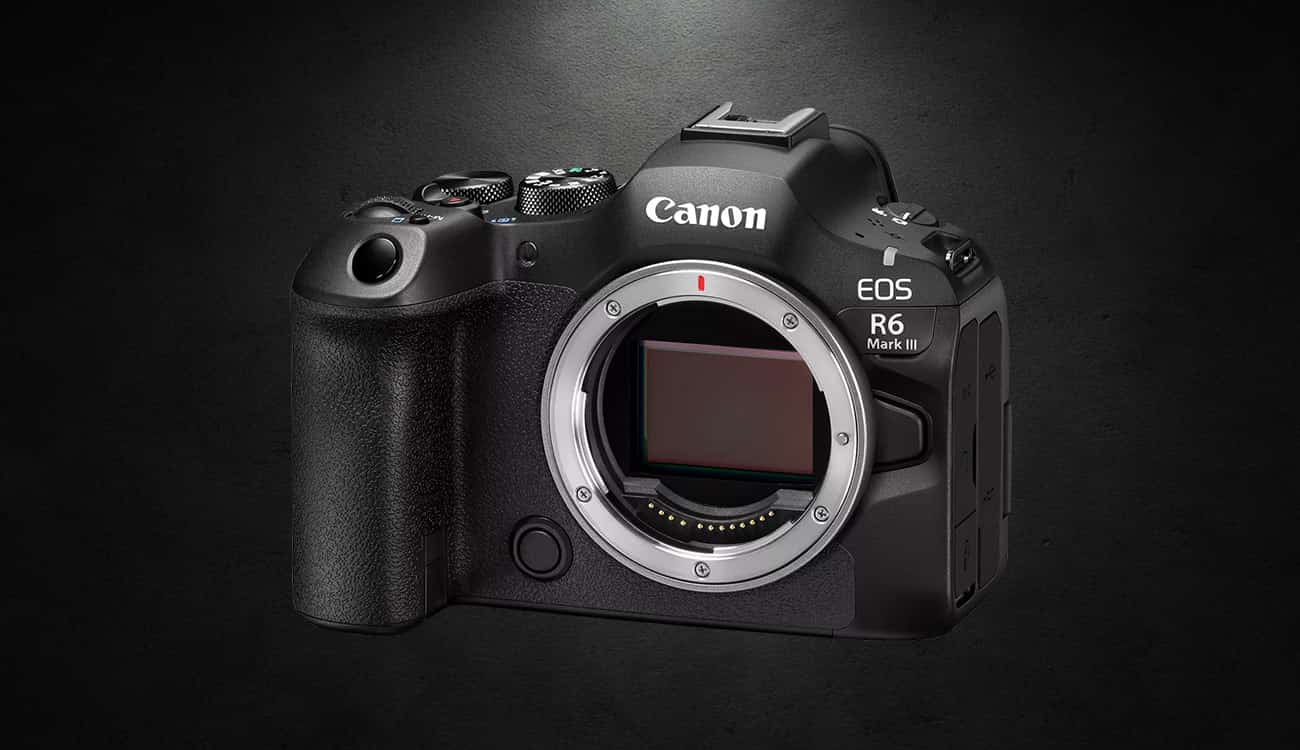
Canon EOS R6 Mark III: The 7K Hybrid That Wants to Be Your Cinema B-Cam
The Canon EOS R6 Mark III isn’t just a mild refresh of the R6 line — it’s essentially
a compact sibling to Canon’s Cinema EOS C50. You get the same 32MP full-frame sensor, 7K 60p RAW, open gate,
oversampled 4K, Canon Log 2/3, and Canon’s latest Dual Pixel CMOS AF II, all wrapped in a stills-style body
with IBIS. For hybrid shooters or working DPs who need a serious B-cam or gimbal body to
live next to a C-series camera, this thing is squarely aimed at you.
Buy the Canon EOS R6 Mark III
Affiliate links below help support SLATD at no extra cost to you.
Headline Video Features
Canon loaded the R6 Mark III with video specs that, a few years ago, would’ve been reserved for a Cinema EOS
body only:
- 7K 60p RAW (Canon RAW Light) via CFexpress
- 7K 30p Open Gate (RAW and MP4) for multi-aspect delivery (16:9, 9:16, 1:1, etc.)
- 4K 60p oversampled from ~5.9K and 4K up to 30p oversampled from 7K
- 4K 120p with no crop
- 2K / HD up to 180fps (slight crop in 2K 180p)
- Canon Log 2 & Canon Log 3 with Cinema Gamut
- Pre-shooting / pre-continuous capture up to 20 frames before you fully press the shutter
- CFexpress Type B + SD UHS-II dual card slots for RAW + proxy or relay recording
- Full-size HDMI Type A with 7K ProRes RAW output to compatible external recorders
On paper, that’s a huge jump over the R6 Mark II and puts the R6 Mark III nearly on par with the EOS C50
in terms of imaging pipeline.
Sensor, Processor & Dynamic Range
The EOS R6 Mark III uses the same 32.5MP 3:2 full-frame sensor as the EOS C50. That’s a big
change from the 24.2MP sensor used in the EOS R6 Mark II, and it means the R6 Mark III and C50 share a
very similar image character.
- Sensor: 32.5MP full-frame CMOS (same as EOS C50)
- Processor: DIGIC DV 7 (shared with C50, C80, C400, C500 II, C300 III)
- Claimed dynamic range: 15+ stops in Canon Log 2 (one stop less than C80/C400 in FF)
The sensor is not a Dual Gain Output (DGO) or back-illuminated stacked design like the C80,
C400, or R3. So you’re not getting that same ultra-low rolling shutter and boosted AF performance you’d see
from the stacked options, but you are getting proven image science and oversampling from 7K for very clean
4K, 2K, and HD.
Dual Base ISO & Low-Light Behavior
Like the EOS C50, the R6 Mark III appears to offer a dual base ISO design rather than the
triple-base layout of the C80. Expect:
- Two base ISO levels, around ISO 800 and ISO 6400 in Log
- Auto Selection that jumps between bases to keep signal-to-noise ratio optimized while
preserving dynamic range
Practically, this means the camera stays surprisingly clean when pushed in low light, and you don’t have to
baby your exposure when working quickly with available light.
EOS R6 Mark III vs EOS C50 — Same Brain, Different Body
On the imaging side, the R6 Mark III and the C50 are extremely close: same sensor, same processor, similar
RAW options, and the same oversampling pipeline from 7K → 4K. The real differences are in ergonomics,
cooling, and I/O.
Shared or Similar Features
- 32.5MP full-frame sensor
- DIGIC DV 7 processor
- 7K Open Gate and oversampled 4K
- Canon Log 2 / Log 3, Cinema Gamut
- Cinema RAW Light 12-bit as the RAW format
Where the R6 Mark III Differs from the C50
- IBIS: R6 Mark III has in-body stabilization; C50 does not.
- Form factor: R6 Mark III is a traditional stills layout body with an EVF and
mechanical shutter; C50 is a box-style Cinema EOS with a top handle and more mounting points. - Interface: R6 Mark III uses the EOS stills UI with a zoom lever and front record button;
C50 uses the Cinema EOS UI with more direct video-centric controls. - Cooling: C50 has an active cooling fan and is designed for long-form, no-worry recording;
the R6 Mark III is fully weather-sealed and relies on passive cooling, so some 7K/4K
modes have time limits due to heat. - Timecode & VP: C50 is more “virtual production ready” and offers better timecode and
production integration; the R6 Mark III is more hybrid/photo oriented (no dedicated TC port). - Anamorphic: C50 offers multiple anamorphic de-squeeze options (1.3x, 1.5x, 1.8x, 2.0x);
the R6 Mark III can shoot Open Gate but currently has no in-camera anamorphic de-squeeze. - Flash & stills: R6 Mark III supports speedlights, mechanical shutter,
pre-continuous stills, etc.; C50 is video-only.
If you primarily shoot video all day, every day, the C50 still makes more sense as an
A-camera: active cooling, cinema UI, timecode, and anamorphic de-squeeze. If you need a camera that can
shoot high-end video and stills, or you want a lighter, stabilized B-cam to pair with a C-series
body, the R6 Mark III is the better fit.
EOS R6 Mark III vs EOS R6 Mark II — Worth the Upgrade?
If you’re coming from the EOS R6 Mark II, this is what really changes for you.
Core Specs
| Spec | EOS R6 Mark III | EOS R6 Mark II |
|---|---|---|
| Sensor | 32.5MP full-frame | 24.2MP full-frame |
| Max ISO (stills) | ISO 64,000 | ISO 128,000 |
| Drive performance | Up to 40fps (electronic), 12fps (mechanical) | Up to 40fps (electronic), 12fps (mechanical) |
| Pre-continuous shooting | Yes (RAW/JPEG/HEIF) | No |
| Memory cards | 1x CFexpress Type B + 1x SD | 2x SD |
| Register People Priority | Yes | No |
| Video recording | 4K 60p (oversampled), 4K 120p, 7K 60p RAW, 7K 30p Open Gate | 4K 60p (oversampled) max |
| HDMI | Type A (full size) | Type D (micro) |
| Tally lamp | Yes | No |
In short: if you mainly shoot stills and casual video, you can stay on the R6 II. But if video is your
income, the jump to CFexpress, 7K RAW, open gate, full-size HDMI, and Register People Priority AF makes the
R6 Mark III a much stronger production tool.
Recording Formats, Codecs & Oversampling
The R6 Mark III basically inherits the C-series philosophy: oversample from a high-res sensor and give
shooters flexible codecs from H.264/H.265 up to 12-bit RAW.
Oversampling
- 7K capture → 4K (DCI/UHD) for up to 30p
- Approx. 5.9K → 4K 60p
- Open Gate 7K lets you pull a full 4K 9:16 vertical plate from a single shot
On-Board Recording Options
- 7K Cinema RAW Light (Open Gate up to 30p, 12-bit .CRM)
- 7K Open Gate in XF-HEVC S (H.265) or XF-AVC S (H.264) up to 60p
- 4K DCI / UHD with XF-AVC / XF-AVC S / XF-HEVC S, 4:2:2 10-bit up to 120p
- 2K / HD up to 180fps (minor crop in 2K at 180fps)
- Proxy recording to SD card while capturing 7K RAW to CFexpress
- Relay recording and double-slot recording for redundancy
Cinema RAW Light has been around since the C200 and is now well supported in most NLEs. It’s compressed
RAW, but much smaller than traditional RAW formats, and it still lets you dig deep in grading with very
clean color and highlight handling. On the R6 Mark III you get a single RAW Light flavor (not the LT/ST/HQ
choices of the C400), but the trade-off is internal recording to CFexpress in a small body.
H.264 / H.265 Gamma & Color Options (Summary)
Across H.264 and H.265 you can mix and match:
- Gammas: Standard, Canon 709, BT.709, Canon Log 2, Canon Log 3, PQ, HLG
- Color sampling: 4:2:0 or 4:2:2
- Bit depth: 8-bit (H.264) or 10-bit (H.265)
Key takeaway: for any serious work, you can live in 10-bit 4:2:2 with Log 2/3 or HDR gamma,
whether you’re in XF-AVC S or XF-HEVC S.
Media, HDMI & File Management
Canon split the difference between pure cinema and pure stills here:
- Card slots: 1x CFexpress Type B + 1x SD UHS-II
- 7K RAW / Open Gate: requires CFexpress Type B
- Proxies: can be written to SD while RAW lives on CFexpress
- HDMI: full-size Type A, with 7K ProRes RAW output to supported recorders
With XF-HEVC S and XF-AVC S, Canon also standardized the folder structure to match Cinema RAW Light and
XF-AVC, which makes file management more consistent across R6 Mark III and C-series cameras on the same job.
Cooling & Recording Limits
Because the R6 Mark III is fully weather-sealed and doesn’t have an active fan, some high-end modes are
thermally limited. Canon’s internal testing (at 23 °C, Auto Power Off Temp = High) suggests approximate
limits of:
- 7K 60p RAW: ~23 minutes
- 4K 120p DCI: ~35 minutes
- 4K 60p FINE (oversampled): ~23 minutes
- 7K 30p Open Gate: ~36 minutes
- 2K 180p: ~120 minutes
More “normal” modes like 4K 60p Standard and oversampled 4K 30p FINE have no heat-based limits.
Long-form interviews and events in the very heaviest modes are where the C50 (with its fan) still wins.
Dual Pixel CMOS AF II, IBIS & Handling
Autofocus is the same class-leading Dual Pixel CMOS AF II system seen in the C50, C80, R3, and C400:
- AF coverage across the entire sensor area
- Eye / face / head / helmet / animal detection with tracking
- Adjustable AF tracking speed and response behavior
- Register People Priority so you can tell the camera which face to prefer
Stabilization is also improved: Canon claims up to 8.5 stops of coordinated IS combining
optical and in-body stabilization. That’s huge for handheld doc, gimbal-less work, and low-light footage.
On the stills side, you still get up to 40fps bursts and the new pre-continuous shooting
mode that captures frames before you fully press the shutter — great for action, sports, and wildlife.
Ergonomics, Connectivity & Other Features
- Weather-sealed body with a 3.69M-dot EVF (120Hz) and fully-articulating LCD
- Same LP-E6NH battery and BG-R10 grip compatibility as R6 / R6 II
- Dedicated S&F (Slow & Fast) mode on the dial for quick speed-ramping setup
- Updated Bluetooth 5 + dual-band Wi-Fi for FTP/FTPS/SFTP and app control
- USB-C tethering to PC/Mac or phone; UVC/UAC support to use it as a plug-and-play webcam
- Multi-function shoe for Canon’s latest on-camera mics and accessories without extra cables
Price & Kits
The EOS R6 Mark III body launches at around $2,799 USD. There’s also a kit with a 24-105mm
f/4 lens at roughly $4,049 USD. For reference, the EOS R6 Mark II launched at $2,499 and is
now sitting closer to $2,099.
Who Is the R6 Mark III For?
We’re at the point where almost every mid-range hybrid can produce gorgeous images. What separates them now
is workflow and ecosystem. The Canon EOS R6 Mark III is basically Canon’s “FX3 moment”:
a stills-style body that borrows heavily from a cinema camera (C50) and slots cleanly into a larger RF /
Cinema EOS pipeline.
If you:
- Own or plan to own a C50 / C80 / C400 and want a B-cam with shared color and codecs
- Need Open Gate, 7K RAW, 4K 120p, and oversampled 4K in a compact, stabilized body
- Shoot a mix of stills + video, and want one camera to cover both professionally
…then the R6 Mark III makes a lot more sense than an R6 II. If you’re all-in on long-form video with audio,
timecode, anamorphic monitoring, and fan-cooled reliability, the C50 is still the better
primary camera — and the R6 Mark III is the hybrid, gimbal, and crash-cam that wants to live right beside it.